Living near Topsail Island means enjoying beaches, waterways and a strong coastal community. It also means preparing for weather that can disrupt normal routines with little notice.
Residents in Hampstead, Surf City, Holly Ridge, Topsail Beach, North Topsail Beach and Sneads Ferry may need to respond to hurricanes, flooding, power outages or evacuation orders. When that happens, knowing where to find important household information can be just as valuable as having batteries, water and other emergency supplies.
Insurance policy numbers, medication details, emergency contacts, property records and photographs are often spread across filing cabinets, phones, email accounts and desk drawers.
Organizing those records before a storm can make evacuation, insurance reporting and recovery considerably easier.
Why household records belong in your storm plan
Most emergency preparations focus appropriately on immediate physical needs. Families stock food and water, charge devices, secure outdoor property and monitor local weather reports.
Important records can be overlooked because they do not seem urgent until they are needed.
After a damaging storm, you may need to:
- contact an insurance company;
- identify damaged or missing property;
- provide information about prescriptions;
- reach family members or service providers;
- document the condition of a home or rental property;
- locate loan, vehicle or ownership information; or
- recall model and serial numbers for damaged equipment.
Trying to reconstruct those details while handling an evacuation or property damage creates unnecessary stress.
The federal government’s Emergency Financial First Aid Kit recommends organizing household identification, financial and legal records, medical information and important contacts before an emergency occurs.
The goal is not to carry every original document with you. It is to know what exists, where the originals are protected and how to reach the information you may need.
Start with a household inventory
A home inventory is one of the most useful records a coastal household can prepare.
Walk through the home one room at a time and document significant property. Begin with items that would be difficult or expensive to replace.
Useful details may include:
- the item’s name and description;
- manufacturer and model;
- serial number;
- approximate purchase date;
- original or estimated value;
- current location;
- warranty information;
- photographs; and
- receipts, when available.
Do not overlook garages, storage buildings, workshops, boats, outdoor equipment or furnished rental properties.
A video walkthrough can provide useful visual context, but it should not necessarily replace an organized inventory. A written or digital record makes it easier to search for a particular item, identify its serial number and determine whether supporting documentation exists.
Photographs should show the item clearly. For electronics, appliances, power equipment and other serialized property, take a separate photograph of the model and serial-number label when practical.
Document the condition of coastal property
A current record of the property’s condition can help distinguish existing wear from new storm damage.
Before severe weather threatens, photograph:
- the roof and exterior walls;
- windows and doors;
- decks, porches and railings;
- HVAC equipment;
- fences and storage buildings;
- vehicles, trailers and boats;
- major indoor rooms; and
- valuable personal property.
Include wide photographs for context and closer images for important details.
Date the inspection and update it when major repairs, improvements or purchases occur. Do not wait until a named storm is approaching and local stores, roads and service providers are already becoming busy.
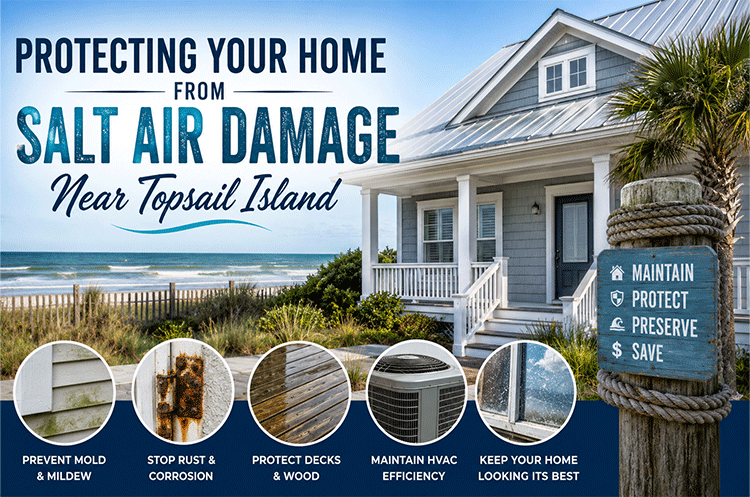
Coastal homes also experience ongoing exposure to moisture and salt. Our guide to protecting your home from salt-air damage near Topsail Island explains why regular inspections matter even when no storm is approaching.
Organize insurance and property information
Create a concise reference record for each relevant policy.
That record might include:
- insurance company;
- policy type;
- policy number;
- agent or claims telephone number;
- website or claims portal;
- coverage period;
- insured property address; and
- location of the complete policy document.
Homeowners, renters, flood, wind, vehicle, boat and rental-property coverage may be handled by different companies. Keeping a simple reference list reduces the number of accounts and documents you must search during a stressful situation.
Do not assume that one policy covers every kind of coastal damage. Review questions about coverage, deductibles and exclusions directly with a qualified insurance professional before storm season.
Keep medical information accessible
An evacuation or extended power outage can interrupt normal access to healthcare information.
Each household member should have an understandable record containing the information that would be useful during an emergency. Depending on individual needs, this may include:
- current medications;
- dosage and instructions;
- prescribing doctor;
- pharmacy contact information;
- allergies;
- important medical conditions;
- health-insurance information; and
- emergency contacts.
Review medication information whenever a prescription changes. An outdated medication list can be more confusing than having no list at all.
The purpose is not to create a complete medical history. It is to preserve the practical information that may be needed if normal records are temporarily difficult to reach.
Build an emergency contact list that works without your phone
Many people keep every telephone number in their mobile phone and nowhere else.
That works until the phone is lost, damaged or out of power.
Prepare a concise contact list that includes:
- household members;
- an out-of-area family contact;
- insurance companies;
- doctors and pharmacies;
- utility providers;
- property managers;
- neighbors who may need assistance;
- local government information sources; and
- important home-service providers.
Keep a printed copy with emergency supplies and an accessible digital copy. Make sure another trusted household member knows where to find it.
During an emergency, rely on official local sources for evacuation orders, shelter information and public-safety instructions.
Use both physical and digital protection
Important originals may still need physical protection.
Store irreplaceable documents in an appropriate secure location, such as a water-resistant and fire-resistant container or another protected location suitable for the document. Avoid leaving critical originals in an exposed desk drawer or ordinary cardboard box.
Digital records provide a second layer of access, but they should not be your only preparation.
A practical system may include:
- protected original documents;
- printed emergency reference information;
- organized digital records; and
- a secure backup stored separately from the home.
The Ready.gov disaster checklist recommends protecting originals, keeping copies and considering secure backups for important computer files.
The exact combination will vary by household. The important principle is that one damaged device, flooded room or lost folder should not eliminate every copy.
Be selective with sensitive information
Preparing for an emergency does not mean putting every confidential detail into one document.
Record what serves a clear purpose. Consider whether a full account number is necessary or whether the institution’s name, contact information and a limited identifying reference would be sufficient.
Protect digital accounts with strong, unique passwords and secure the email account used for password recovery. Sign out when using shared devices, and avoid sending sensitive records through unprotected messages.
If another person may need emergency access, decide in advance what they should be able to reach and how that access will work. Do not wait until an emergency to discover that all essential information is locked behind an unavailable device or an account only one person understands.
Use a simple one-hour starting plan
Organizing everything at once can feel overwhelming. Start with a one-hour session.
First 15 minutes: Create the basic list
Write down your insurance companies, emergency contacts, doctors, pharmacy and locations of important original documents.
Next 20 minutes: Photograph the home
Walk through the main rooms and photograph significant property. Include outdoor equipment and vehicles if time allows.
Next 15 minutes: Record priority items
Add identifying details for the most valuable or difficult-to-replace possessions. Concentrate on model numbers, serial numbers and approximate values.
Final 10 minutes: Protect and back up
Place the records in their intended physical and digital locations. Confirm that another trusted household member knows where the emergency information can be found.
The first version does not need to be perfect. A basic, accessible record is more useful than an elaborate system that never gets started.
Modern tools can make records easier to maintain
Digital organization is most helpful when it reduces the effort required to keep information current.
Web-based applications can make records available from different devices without requiring a separate document to be maintained on each one. Progressive web applications can also provide an app-like experience through modern browsers, although specific installation and offline capabilities depend on the application, device and browser.
The technology matters less than the workflow.
A useful system should make it easy to add a household item, update a medication, record a property expense or locate information without searching through several unrelated files.
DecaVault’s personal organization tools include focused areas for home inventory and assets, doctors and medications, mileage, personal loans and rental-property records. Topsail-area residents can also find DecaVault in the Topsail Advertiser business directory.
For a broader explanation of how to build a maintainable recordkeeping system, see Why Simple Personal Organization Tools Work Better.
Review the records before they are needed
Household information changes throughout the year.
Policies renew. Medications change. Property is purchased or sold. Repairs are completed. Telephone numbers and emergency contacts change.
Schedule a review at least once each year and after any significant change. Coastal residents may find it useful to perform that review before the Atlantic hurricane season becomes active.
During the review:
- confirm that contact information is current;
- update medication and appointment details;
- add major purchases;
- remove property you no longer own;
- update photographs;
- check insurance references; and
- verify that backups are still accessible.
A record that cannot be found, opened or understood is not ready for an emergency.
Preparation reduces avoidable stress
No organizational system can prevent a storm or eliminate the difficulty of recovering from one.
It can, however, remove some avoidable uncertainty.
When household records are organized, coastal residents can spend less time searching for policy numbers, medication details, property information and emergency contacts. That leaves more attention for protecting people, following official instructions and beginning recovery.
Start with the information that would be most difficult to reconstruct.
Keep the system simple enough to update.
Then make sure the people who may need it know how to find it.